The training

Educational objectives:

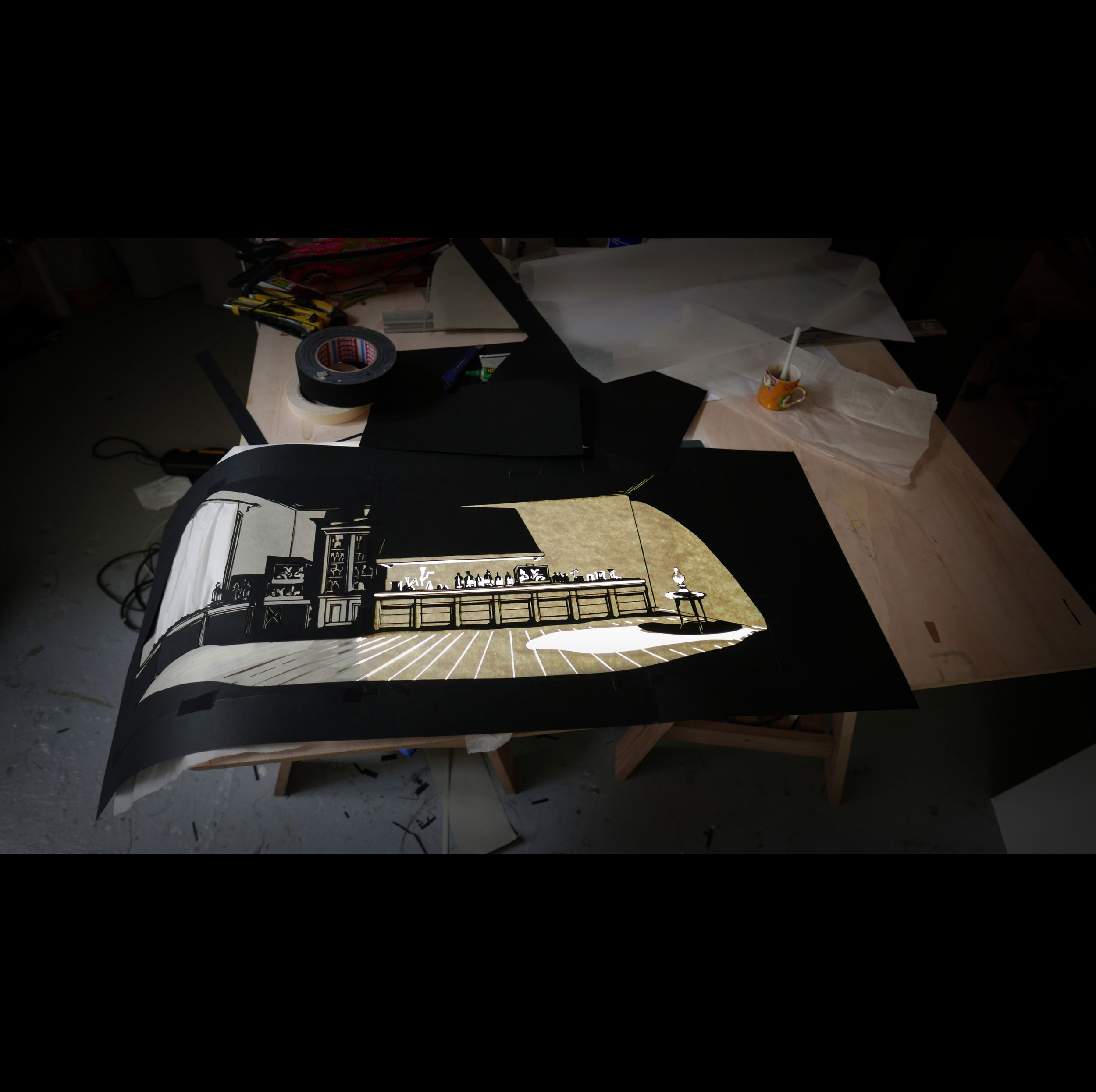
This course offers an immersion in the rich and subtle world of canvas painting and trompe-l’œil, in the finest tradition of mural and stage painters, from Mengozzi Colonna to Ciceri.

Mathieu Lemarié guides you through a variety of techniques and methods — drawing, stencils, transfer, tracing, fixing, patinas, stippled glazes, textural effects, ornamentation, shading and finishing touches — to give character and individuality to every part of the decoration.

Drawing inspiration from motifs seen together in a Venetian palace, the aim is to reproduce and understand the techniques involved, and to master the necessary skills. Ultimately, the objective is to find a new balance, drawing on composition and the harmony of tones, in the manner of stage designers.

This approach, which is both sensitive and technical, invites you to explore the link between intention and aesthetics, between craftsmanship and expression. A course for those who wish to go beyond simply applying colour and create unique pieces, in the style of the old masters.

By the end of the course, participants will be able to:

  • Experiment with decorative painting techniques
    Glazing, textural effects, the breakdown of light and shadow tones, and the synthesis of ornamentation will be explored through practical exercises.
  • Develop an artistic and sensitive approach to decoration.
  • Integrate traditional skills into a contemporary approach.
  • Master craft-based techniques to create unique pieces in line with current trends.
  • Design and carry out a decorative project from start to finish.

Training content

Mathieu Lemarié introduces participants to various decorative painting techniques on small canvases and guides them through the creation of individual projects, which form part of a collective project.

Day 1: Introduction to decorative painting and guided tour

Afternoon

  • Welcome: introduction to Mathieu Lemarié, his previous work and the course programme, followed by an introduction to the various participants.
  • Introduction to the workshops, the various surfaces and the tools.
  • Presentation of the planned project and the time required to complete it during the week. Handing out of the necessary design documents.
  • Departure by vaporetto and a visit to a Venetian palace to observe ‘in situ’ the traditional decorative painting techniques used by the masters of the 17th and 18th centuries. Accompanied by Mathieu Lemarié, participants will discover these techniques and their specific characteristics so that they can reproduce some of them on canvas during the week.

Day 2: Patina techniques

Morning

  • Interpretation of a decorative motif from the Palazzo Labia and analysis of its various parts to understand the challenges involved: reading architectural perspective, studying the ornamentation and breaking it down into motifs.
  • Presentation of the various techniques for preparing drawings: breaking down a coloured image into drawings, transferring the drawings to create large-scale templates, using a projector and a marking cord, identifying any vanishing points and tracing with string. The enlarged drawings are then corrected in order to produce stencils.

Afternoon

  • Division of labour within the group: participants form pairs and prepare a drawing on kraft paper, transferred to a defined scale, which will be used by the whole group.
  • Finalising a set of stencils enabling everyone to transfer a complete drawing onto a large-format canvas. Exploring techniques for fixing the drawing.

Day 3: Backgrounds, colour and glazing — Applying colour with a stencil

Morning

  • Preparation of coloured backgrounds: Mathieu Lemarié presents, using samples, several shades prepared from pigments. Participants then individually create the coloured bases for their projects.
  • Work on successive transparent glazes applied with a stencil in earth tones: raw and burnt sienna, raw and burnt umber, ochres, Van Dyck brown, etc. The aim is to layer the tones and gradually increase the density and intensity of the colour, whilst keeping the drawing visible through the transparency to enable the subsequent creation of the trompe-l’œil effect.

Afternoon

  • Presentation by Mathieu Lemarié providing a detailed description of the production process as implemented by his teams on large-scale projects. Step by step, he outlines the methods, tools, suppliers, techniques and organisation of the work, then answers questions from participants, who now have a better understanding of the practice.
  • Creation of trompe-l’œil sketches at the end of the day.

Day 4: Trompe-l’œil in painting, marbling and compositional balance

Morning

  • Building on the coloured backgrounds created previously, Mathieu Lemarié outlines the steps involved in constructing the trompe-l’œil, broken down into layers, in the style of hand-printed wallpapers, such as those by Zuber.
  • Creating trompe-l’œil effects on mouldings, columns and capitals. Pictorial synthesis of complex elements, particularly in the rendering of cast shadows.

Afternoon

  • Demonstration of faux marble: Mathieu Lemarié presents an example of the technique, which each participant then puts into practice directly on their own canvas.
  • Finalising each participant’s trompe-l’œil.
  • Demonstration of faux wood using ‘boisette’. Each participant then has a turn to experiment with this technique on a practice canvas.

Day 5: Creating and finalising the décor

Morning

  • Painting the sky: using common colour tones, each participant creates a small painted model of their sky. Building on this, participants then paint their sky on a large scale, either at a table or standing on the floor, using one-metre-long brushes, in the style of opera and theatre set design workshops.

Afternoon

  • Finalising the painting of the sky.
  • Tidying up the workshop.
  • Photographing the collective work produced by the group 

Trainers

with Mathieu Lemarié

Matthieu Lemarié

The principle of illusion is at the heart of decorative art, and Matthieu Lemarié excels in this field. He practices painting in a wide variety of forms, encompassing both decorative arts and craft techniques: monumental frescoes, delicate illuminations, glazed ceramic tiles, painted canvases for the opera house, striking trompe-l'œil effects, and faithful reproductions for film. His unique expertise leads him to collaborate with prestigious clients such as renowned museums, famous directors, and leading institutions.

He contributes to the design of sets for numerous operas in iconic venues such as the Paris Opera, Versailles, and Rouen. His talents are also sought after by figures in the artistic world, such as Ariane Mnouchkine, Zingaro, and Cirque du Soleil, for whom he designs spectacular sets.

Film was his first creative outlet after graduating, where he participated in the creation of frescoes for the film "Vatel." Subsequently, he collaborated with directors such as Jean-Pierre Jeunet, Roman Polanski, Alain Chabat, Éric Rohmer, and Woody Allen, for whom he even painted a fake Picasso.

Recognized for his expertise in the decorative arts, Matthieu Lemarié also works in museum scenography and window display design. Since 2019, the design agency GGSV has been calling upon his services for various large-scale projects, including at the Villa Medici, where his artistry and craftsmanship continue to captivate audiences.

Methods used

  • Classroom, multipurpose room, workshops with professional equipment
  • Materials provided
  • Individual and collaborative work
  • Hands-on workshop activities
  • Active participation and experimentation by participants are encouraged

Monitoring and evaluation procedures

  • Group and individual progress monitoring, with regular updates
  • Self-assessment of technical skills acquired
  • Group feedback session
  • Attendance sheet for each half-day session
  • Certificate of completion issued by Campus MaNa
1950€TTC
5
 days of training
English
French
*The price includes only the cost of the training, including materials and personal protective equipment.

Funding

Training 100% financeable by AFDAS, or partially covered by AGEFICE.

Price: 
2500€TTC

AFDAS can fully fund training courses conducted outside of France, under certain conditions.

This program is for affiliated or registered artists and authors, as well as performing arts professionals working on a freelance basis.

If you are eligible, we encourage you to contact our sales department beforehand via the "Information Request" form to prepare your application, or to register directly through the page of your chosen training course.
Practical information

Target audience:
This course is open to all adult participants who have experience in drawing and painting, regardless of age or formal qualifications.
Level:
Schedules :
10h-13h / 14h-18h
Venues & organization:
Campus Mana Venezia - à Venise
Cancellation conditions:
21 days before the start of the training
Number of participants:
10
93
%
Training satisfaction rates 2024
crossmenuchevron-down
linkedin facebook pinterest youtube rss twitter instagram facebook-blank rss-blank linkedin-blank pinterest youtube twitter instagram