The training

Educational objectives:

This workshop offers an in-depth exploration of traditional tempera painting techniques, drawing inspiration from the practices of painters from the 14th to the 16th centuries.

Through the study of materials, the preparation of the support, and the various stages involved in creating a historical painting, participants discover a working method based on precise drawing, the gradual build-up of paint layers, and mastery of the medium.

The course draws on the legacy of Italian workshops and the practices of medieval and Renaissance painting: panel preparation, sizing, priming, preparatory drawing, transfer, application of colors, layering, glazing, and finishing.

Particular attention is paid to understanding the techniques of historical painters, their relationship with materials, and the time required to build the image.

  • Discover the fundamental principles of tempera painting.
  • Understand the painting techniques used between the 14th and 16th centuries.
  • Identify the different materials and their functions.
  • Prepare a support using a traditional method.
  • Experiment with preparing a ground suitable for historical painting.
  • Transfer and construct a preparatory drawing.
  • Understand the logic behind the layering of paint.
  • Explore the relationships between drawing, color, light, and texture.
  • Discover the principles of glazing and finishing techniques.
  • Develop a sensitive and well-informed approach to traditional techniques.

Skills Acquired Upon Completion of the Course

Upon completion of the course, participants will be able to:
  • Prepare the main steps for priming a surface for tempera painting.
  • Recognize the characteristics of a tempera painting.
  • Build an image from a precise preparatory drawing.
  • Gradually build up layers of color to create volume.
  • Experiment with different densities, transparencies, and layering.
  • Understand the role of the binder and pigments in painting.
  • Observe and analyze a historical painting based on its technique.
  • Implement a protocol inspired by the practices of historic painting workshops.

Training content

Day 1 — The Support, Materials, and Preparatory Drawing

The first day is devoted to exploring the technical fundamentals of traditional painting.

  • A historical overview of tempera and its development in Italy.
  • Examination of historical paintings: preparation, drawing, layers of paint, and finishing touches.
  • Introduction to materials: pigments, binders, supports, and tools.
  • Preparing the panel.
  • Principles of priming and coating.
  • Preparation and application of the undercoats.
  • Sanding and preparing a surface suitable for painting.
  • Creating a preparatory drawing.
  • Study of proportions, contours, and main construction lines.
  • Transferring the drawing onto the support.

Objective for the day: to understand that traditional painting is built up in stages and that the quality of the image depends as much on the preparation as on the painting itself.


Day 2 — Color, Texture, and Image Construction

The second day delves into the heart of the painting process: the gradual construction of color and volume.

  • Preparing colors and exploring color mixing.
  • Organizing the palette.
  • First application of color.
  • Building forms and values.
  • Gradually layering the paint.
  • Working with light and volume.
  • Differences between opacity, transparency, and saturation.
  • Shaping the face, fabrics, and architectural or decorative elements.
  • Study of details and their role in composition.
  • Introduction to glazing and depth effects.

Particular attention is paid to the patience of the brushstroke, the subtlety of the layers, and the way an image is built up gradually rather than through the immediate application of color.


Day 3 — Finishing Touches, Light, and Interpretation

The final day provides an opportunity to delve deeper into the work and discover the steps that give the painting its unity and depth.

  • Revisiting and enriching the layers of paint.
  • Working on details and highlights.
  • Glazes and nuances.
  • Enhancing contrasts.
  • Working with textures: skin, fabric, wood, metal, architecture.
  • Observing lighting effects in old master paintings.
  • Finishing touches and harmonizing the overall composition.
  • Group analysis of the works.
  • Comparing the works with historical pieces.
  • Presentation of the creative process and reflection on technical choices.

The day concludes with a discussion on the possibility of reinterpreting traditional techniques in a contemporary context, without losing their technical rigor or material richness.

Trainers

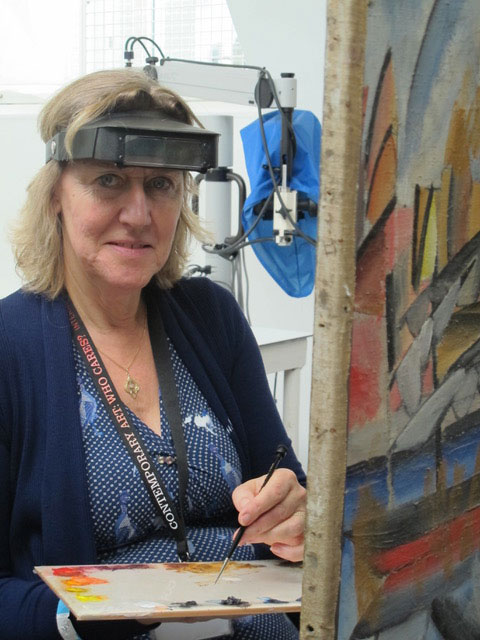
with Louise Wijnberg

From a young age Louise Wijnberg had a passion for cultureand the visual arts and especially the technical side of it.

To become a technical art historian, she studied at the Sorbonne in Paris, Art History and Conservation and Restoration of Cultural Heritage. She specialized in the conservation of aasel paintings and concluded her study with a doctorate. She lived for ten years in Paris and was some time involved with ICOMOS and ICOM (International Council of Museum) linked to UNESCO.

A long-standing career of three decades followed as painting conservator at the Stedelijk Museum of Modern and Contemporary Art in Amsterdam, where she was also involved with the scientific research of different conservation topics and the technique of Artists. She published many articles in international journals and books.

In 2018 she founded her own company of conservation and restoration and is active in teaching at Institutions and University’s and giving workshops on an international level. All based on her long-standing experience.

Her interest is not only focussed on Modern Arts but was always open to other special fields. One of them is Venice, it’s history, art’s history and architecture. She professionally visits Venice yearly. She travelled in the past several times as courier to Venice as conservator to accompany works of art for different Biennales.

She got this year a contract at the RCE – The Dutch National Heritage Agency - in Amsterdam for a special research projects on a

Methods used

The training program alternates between:

  • Technical demonstrations.
  • Guided practical exercises.
  • Observation of historical works.
  • Preparation and handling of materials.
  • Individual guidance.
  • Painting experiments.
  • Group analysis of student work.

The curriculum emphasizes a progressive and hands-on approach, allowing students to understand techniques through practice and observation.

Monitoring and evaluation procedures

Assessment takes place throughout the training program through:

  • Completion of the various technical steps.
  • Progressive mastery of tools and materials.
  • Understanding the process of image construction.
  • The ability to observe and analyze a historical painting.
  • The creation of a study or a final project in tempera.
1490€ incl. VAT
3
 days of training
English
French
Italian
*The price includes only the cost of the training, including materials and personal protective equipment.

Practical information

Target audience:
The course is open to all adults, regardless of age or educational background.
Venues & organization:
Campus Mana Venezia - à Venise
Cancellation conditions:
21 days before the start of the training
Number of participants:
15
93
%
Training satisfaction rates 2024

Pay online

crossmenuchevron-down linkedin facebook pinterest youtube rss twitter instagram facebook-blank rss-blank linkedin-blank pinterest youtube twitter instagram